
About
A small library of bass lines anyone can learn. Each one comes with playable notation and tab, drums to play along with, a printable line sheet, and the story of where it came from.
Who's playing
I'm a beginner on bass. I'm not a beginner on these records. I've listened to them all for years, most of them decades, so I know these bass lines by heart. But I didn't understand them musically, much less have any ability to play them on an instrument until now. I got tired of digging through tab sites, sometimes struggling to find a deep cut, and often finding them hard to decipher or even wrong, so I started this little library.
Many of these bass lines lean toward the "golden age" of hip hop, and that's because I spent some of my formative years listening to that genre. It was fun witnessing and even participating in a new form of American music remixed from earlier music, and embraced by a new DIY generation. I later expanded my musical interests considerably but those early hip hop days still form an undercurrent of appreciation for beats and bass lines.
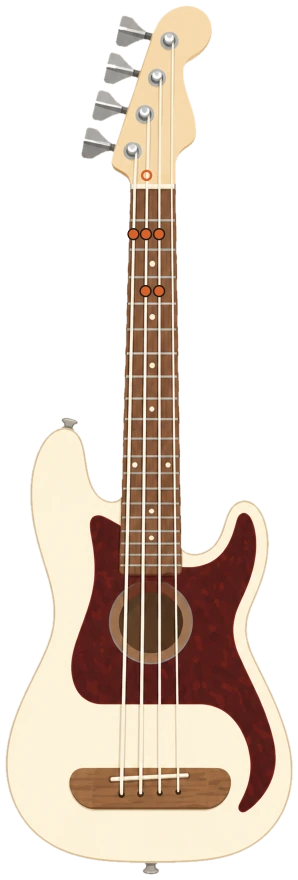
Every line here is one I play myself, on a Fender Fullerton ukulele bass, filmed on the coping of my mini ramp. Yes, I'm a skateboarder, a pretty serious one, and I've been doing it long enough that I was once a bit of an oddity in those early years, programming drum machines and scratching records when everyone I skated with was moshing. Since I play these bass lines on my mini ramp, I thought it would also be fun to pair each with a skate trick of roughly similar difficulty. You'll find both in the accompanying video for each line.
The Fullerton uke bass is a fun simplification, but you can play these on any bass, and I do. One thing I didn't expect: most uke basses use rubbery polyurethane strings, but the Fullerton ships with metal roundwounds, and they're noisy. Every slide and sloppy lift squeaks. That's pushed me toward cleaner technique than my full-size basses with quieter strings ever did. Some players swap in flatwounds to quiet them down. I haven't tried it. About the name, since it trips people up: Fender's Fullerton series is named for Fullerton, California, where the original Fender factory stood. It isn't named for George Fullerton, Leo Fender's right-hand man for decades. The city itself was named in 1887 for a different man entirely, George H. Fullerton, the president of a railroad land company.
Why tiny
The tiny in Tiny Bass Lines is on purpose. My plan as a beginner is to get good at simple lines before venturing out, and these old school lines are perfect for that. They're short, they repeat, and there's nowhere to hide in them. With a handful of notes, the things a busy line lets you skate past become the whole job: how long each note rings, where it lands against the kick, how it stops. I'm Your Pusher isn't hard to play, but it falls flat unless every note is held just right.
My guidepost here is Thelonious Monk, who was anything but simple. Around 1960 the saxophonist Steve Lacy wrote down advice Monk gave his band, and one line stuck with me: "What you don't play can be more important than what you play." Monk earned that economy by mastering everything else first. I'm starting there on purpose, hoping the restraint sticks with me as the lines get bigger.
How a line gets in
The bass is the hook. If you hum the song, you're humming the bass line.
There's something you probably don't know about it. Who really played it, where it really came from, what it really is, or how it really works. The best ones set the record straight.
I knew it by ear first. Every line lived in my head for years before I ever saw it written down.
Lines that show up on every "easiest bass riffs" list only get in if there's a story nobody tells.
Verified by playing
Every line is checked by ear against the record and played on camera. This whole site is a working beta: it's live for ease of testing, kept out of search engines, and I'm still learning in public, so the format and the lines keep changing. Lines still being checked are marked draft, with a note saying what's left to confirm. I am still very much learning, so hit me up if you see something obviously wrong.
Difficulty, for a beginner
Difficulty here is measured from where I started: someone who could spell bass and that's about it. A 1 is a line you can play along with in your first week. A 5 would take a beginner months, often involving more speed or a technique like slapping or strumming.
It also weighs how far your fretting hand travels, how tricky the rhythm is, and how fast or how long the line runs. It doesn't count notes: a long line that sits still can be easier than a short one that jumps around.
- 1. Few notes, no shifts, steady rhythm. I'm Your Pusher is a 1.
- 2. A little syncopation, or a few more notes.
- 3. Busier rhythm, more string changes.
- 4. Speed, endurance, or one tricky move.
- 5. The hardest lines on the site.
New to notation? How to read a line →
The long version
Each line's full story runs as an essay on michaelmorrison.com and has lots of fun background info on who played what, and how, which can be tricky to pin down in the sampling era of early hip hop.